
The First 90 Days: Why Asset Tagging Matters in Contract Operations Management
Asset Tagging During Contract Mobilization: Building a Baseline You Can Defend
Winning a new facilities management contract is exciting. It means a client has trusted your team to operate, maintain, and protect a complex physical environment — a university campus, a hospital, an airport, or another large facility where uptime matters and expectations are high.
But anyone who has worked in contract operations knows the first few months are not just about getting work orders flowing. They are about getting control.
And one of the first questions is deceptively simple:
What exactly are we now responsible for?
That question sits at the center of every new contract mobilization. Before a facilities team can plan preventive maintenance, assign labor, forecast parts, manage risk, or report confidently to the client, they need a reliable asset baseline. They need to know what equipment exists, where it is, what condition it is in, how it is identified, and whether it is actually in scope.
That is where asset tagging becomes much more than an administrative task.
For a contract operations company, asset tagging is one of the first acts of operational accountability.
The handoff is rarely clean
In an ideal world, a new facilities provider would receive a complete, accurate asset inventory on day one. Every air handler, pump, boiler, chiller, generator, panel, elevator, fan, and specialty system would already be listed in the client’s CMMS or EAM system. Each record would have a consistent naming convention, a clear location, a current condition rating, a maintenance history, and a tag that matches the physical equipment in the field.
In reality, the starting point is often much messier.
Some assets are missing from the system. Some were replaced years ago but never updated. Some have duplicate records. Some have handwritten labels, old barcodes, faded metal plates, or no tag at all. Location data may be inconsistent. Nameplate information may be buried in photos, PDFs, spreadsheets, or the memory of a long-time technician.
And yet the contract clock has already started.
The provider is expected to respond to service calls, meet SLAs, execute preventive maintenance, support compliance needs, and give the client confidence that the transition is under control. That is a lot to ask when the team is still discovering the physical environment.
This is especially true in campuses like universities, hospitals, and airports. These are not quiet facilities where operations can pause while inventory work is completed. They are active, high-visibility environments with students, patients, passengers, staff, tenants, researchers, visitors, and regulators moving through them every day.
The work has to happen while the facility keeps running.
Tags define more than assets
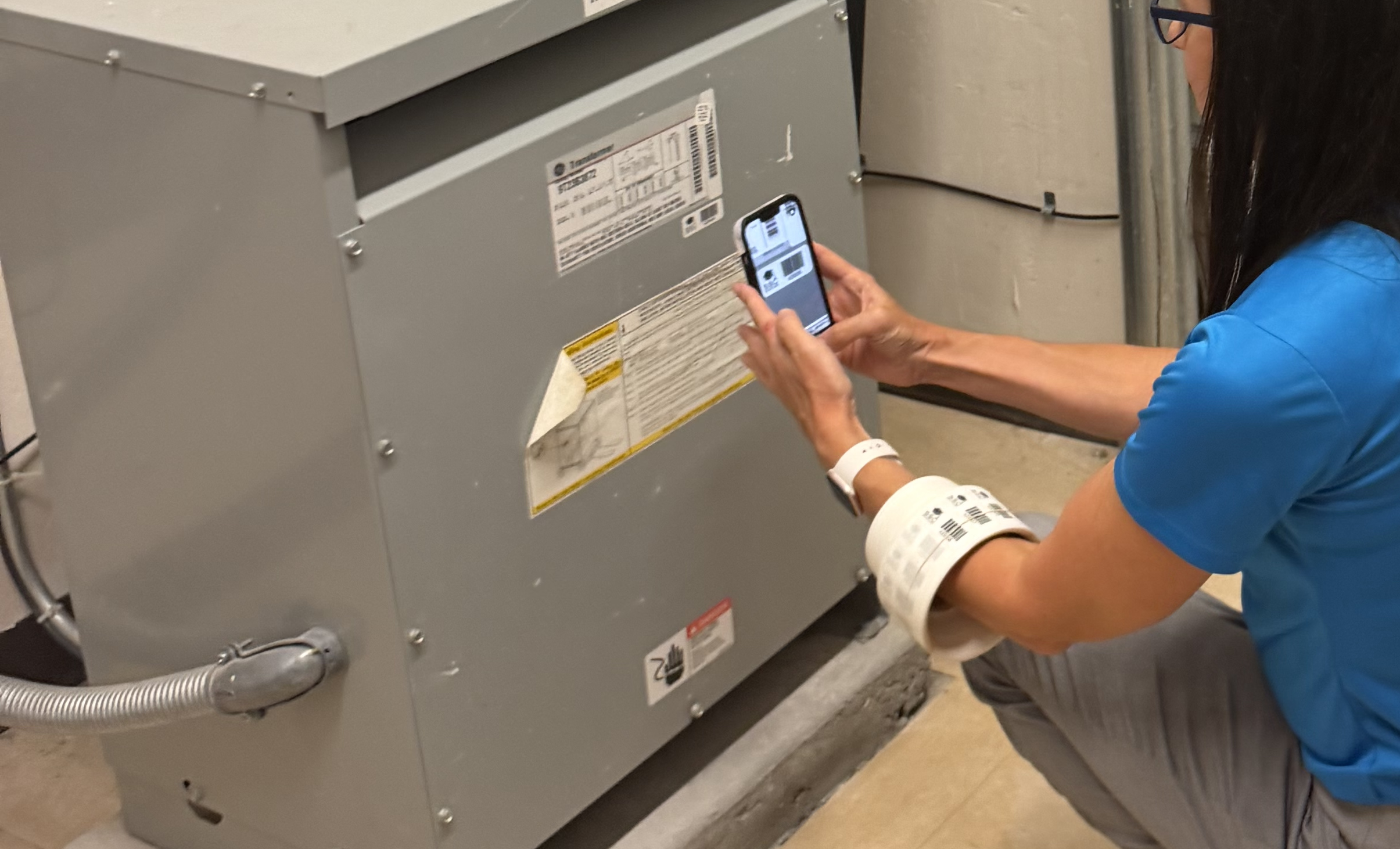
When a technician applies a barcode sticker, QR code, RFID label, or metal tag, they are doing more than marking equipment. They are helping define the operating model.
That tag becomes the link between the physical asset and the digital record. It tells the maintenance team, “This is the asset we are talking about.” It supports preventive maintenance scheduling, work order history, parts planning, condition assessment, compliance documentation, and capital planning.
In contract facilities management, it also helps define scope.
Is this asset included in the base contract? Is it client-maintained, subcontractor-maintained, tenant-maintained, or billable as extra work? Was it in poor condition at takeover? Is it safety-critical? Does it require regulatory inspection? Does it belong to a larger system or parent asset?
These details matter because they affect risk, staffing, budget, and performance expectations. Without a trusted baseline, every future conversation becomes harder. Was the equipment already failing? Was the PM missed, or was the asset never in the system? Was that asset included in the original scope? Who is responsible for repair versus replacement?
A clean asset tagging and documentation process helps remove ambiguity before it becomes conflict.
The old process creates too much rework
Most facilities teams know the traditional workflow too well. A field team walks the site with clipboards, spreadsheets, mobile forms, cameras, and printed floor plans. They tag assets, take photos, write down nameplate data, record locations, and make judgment calls in the field.
Then the real work begins.
Someone has to reconcile the notes, match photos to assets, interpret handwritten values, normalize naming conventions, remove duplicates, complete missing fields, and prepare data for import into a CMMS or EAM system. If photos are blurry or nameplates were missed, the team may need to revisit the asset. If field crews use inconsistent terms, the CMMS administrator inherits the cleanup.
For a contract operator in the middle of mobilization, that rework is not just frustrating. It consumes time, budget, and management attention at the exact moment the team needs to be building trust.
What good looks like
A successful mobilization does not require perfection on day one. But it does require momentum toward a reliable operating baseline.
Good looks like every maintainable asset being tagged, photographed, classified, located, and tied to a structured digital record. It means field technicians can capture the data without becoming data entry specialists. It means maintenance managers can build PM programs from real equipment, not assumptions. It means CMMS administrators receive usable records instead of a cleanup project. It means account leaders can show the client what was found, what was missing, what is in scope, and what needs attention.
Most importantly, it means the provider can move from inherited uncertainty to operational control.
A better way to build the baseline
MentorLens™ was built around a simple idea: what if collecting asset data was as easy as taking a picture?
Instead of relying on manual surveys and weeks of reconciliation, technicians can capture asset photos in the field. MentorLens extracts plate and tag data, identifies asset attributes, supports condition assessment, and creates structured, standardized records that can be used across asset management workflows. Internal MentorLens positioning describes this as turning field photos into structured asset records, reducing manual entry, and helping organizations build trusted asset datasets faster.
That matters for contract operations because speed alone is not the full value. The bigger value is confidence.
MentorLens supports high-volume asset capture across building portfolios, standardized taxonomy, evidence-based condition documentation, and a “living baseline” that can continue improving over time rather than becoming another static inventory.
For a facilities provider taking over a new contract, that can change the entire mobilization experience.
The asset inventory is no longer just a box to check. It becomes the foundation for service delivery, client transparency, capital conversations, and long-term performance.
Because in contract operations management, the first challenge is not always fixing the asset. It is knowing the asset exists.

Connect with Us

